

The Past Presents: Arlette Lucero
Interviewed & Edited by Tommy Clift in 2023.
The Past Presentsis a series highlighting artists from the denver undrgound magazine, Worldview’s predecessor. These are Arlette’s words directly from the conversation.
My great-grandfather was one of the earliest settlers and founders of a place called Garcia, in Colorado. He was the principal of the school there. My parents were both from Colorado. My father came over from Mexico. My parents were active in the Chicano movement, meeting with Cesar Chavez and working for Corky Gonzales for the Crusade for Justice La Raza Unida third party. They owned a bilingual publishing company called Totinum Publishing. Later my mother owned the first bilingual bookstore called El Camino Real. We’re very, very rooted. I never moved outside of Colorado and haven’t veered very far from Denver. I lived here all my life, and so this is my place. I’ve seen it grow and change and evolve.
Artist, Educator:
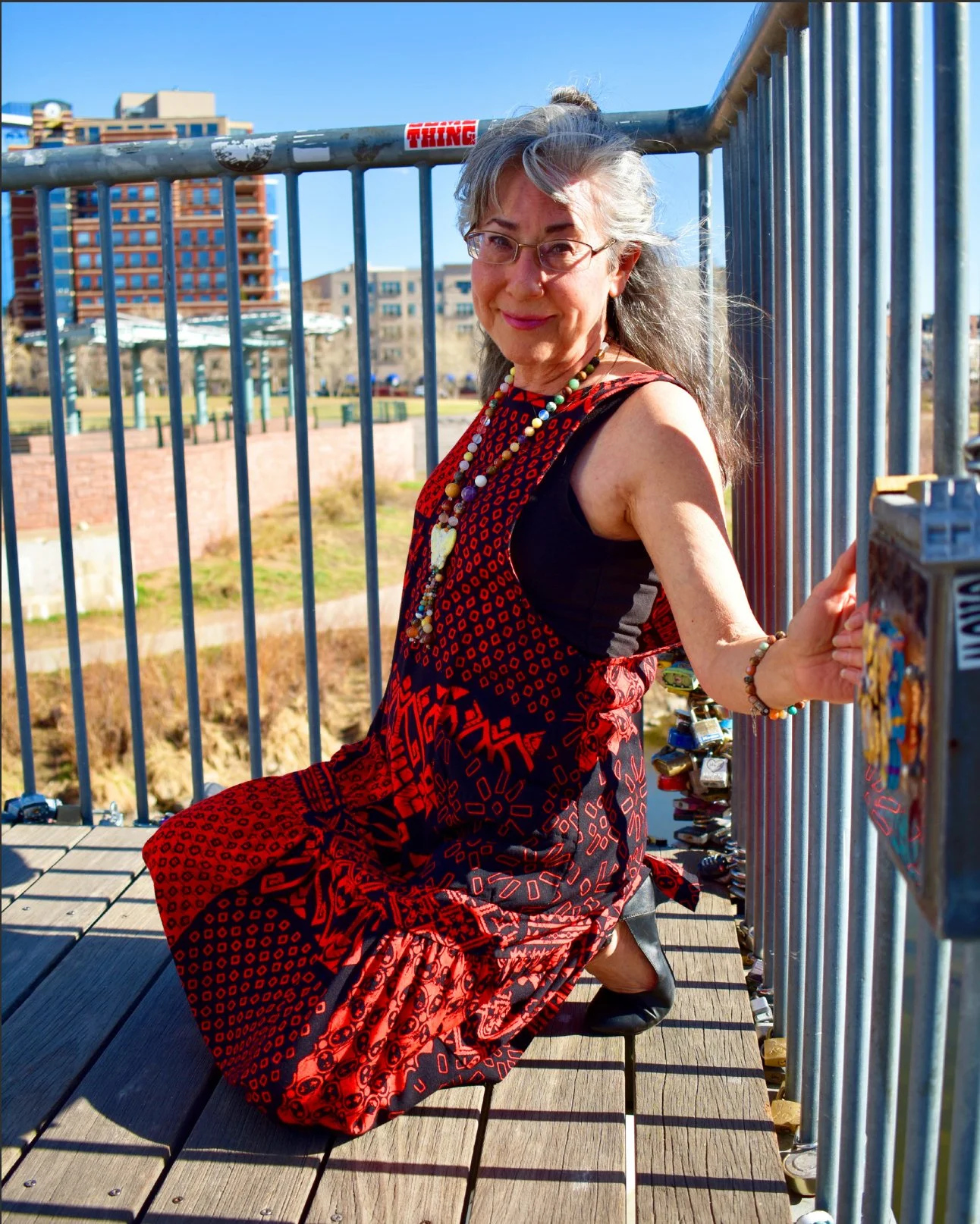
For me, the idea of drawing was always there. And I had an auntie who helped me draw. For Christmas, she bought me a ream of white paper and some pencils. And for some reason, that excited me more than all the other gifts. It was the one that really stayed in my mind. I had all this blank paper. I could draw to my heart’s content. I could draw whatever I wanted, whenever I wanted. That’s where it started: with my auntie. But it was also in my innate desire because nobody else felt that same way. And since I was a pretty solitary person, two things played big, and that was my art and reading.
(photo by Avery White @xkingxaveryx)
I loved to read when everybody else was out socializing. I’d be there with a book in my hands or drawing pictures. And I’d get in trouble in school because you have this big old desk, all blank and ready to go. So I would just fill the whole desk with drawings. And of course, every day I would get in trouble and would have to clean off all the desks after school every day.
But it was irresistible to me. It still is. If I have a piece of paper in front of me, I’m doodling away as I’m listening.The painting really didn’t start actually until I went to college. My parent’s generation, they didn’t see the potential of what doing art could bring to a person. And, you know, I didn’t see that at first, either. But then I began to see that art was everything, everywhere. Art is everywhere. And now it is even more so, I think. We’re surrounded by art and thank God. We would be nothing, we would be boring little creatures if we never had art. Two things really played big in my adult life: being an artist, and being an art educator. I would take my siblings, I would sit them down, and I would say: we’re going to do a contest, we’re going to make a picture of this, that, or the other. I’d give them all papers: let’s just play with this. So I was also the educator, I guess.
When I really started getting into it as an adult... we employed a group of kids to come in and do a mural that ended up at the Deborah Human Services Building. And when I was doing that, I was just overjoyed. And I thought, this is what I want to do. Working with all of these young minds, us all working together to create this great big, huge mural, I did that for the whole summer.
I’ve also worked in the classroom with kids, with different crafts, and I adore it. I worked with a Catholic school, Guadalupe. And I was there for like, seven years. In the summer before I went into seventh grade, I attended a summer school for Chicano children and youth called Escuela Tlatelolco. It was kind of a cultural shock as I entered and heard everybody singing beautiful songs in Spanish that I had never heard before. This summer program taught traditional arts and Mexican history. I find it so important to pass that knowledge down to the next generations.
I get a kick out of it every time to watch kids and what kind of creations they come up with. I worked with elementary school kids, which worked really well for my personality. They were so enthusiastic, just soaking up all of this information. We made superheroes, we made puppets, we worked with clay, we worked with all sorts of different mediums. I mean, we worked with everything. What I really loved about it was, I could come up with an idea, throw it out to them, and let them go with it. Some of it was cultural, some of it not necessarily just Hispanic-Chicano culture, but other cultures too.
And then suddenly, the kids who are very, very creative would take that cultural idea, and then bring it back to their own personal culture, which I thought was so interesting. And then I would see the kids fighting with each other. And so I would bring you know, the groups of kids who were not working well with each other and say, okay, you guys have to collaborate on this project, and you better make it good because your grade depends on it. And so then they would collaborate with somebody that weren’t working so well together, and they would come up with these brilliant ideas. And it always, always, always amazed me. Kids are kids, you know, they’re going to be noisy, they’re going to be messy. And they’re going to be obnoxious. But if you can get past all that noise and enthusiasm, they’re going to come up with something that’s always going to surprise you.
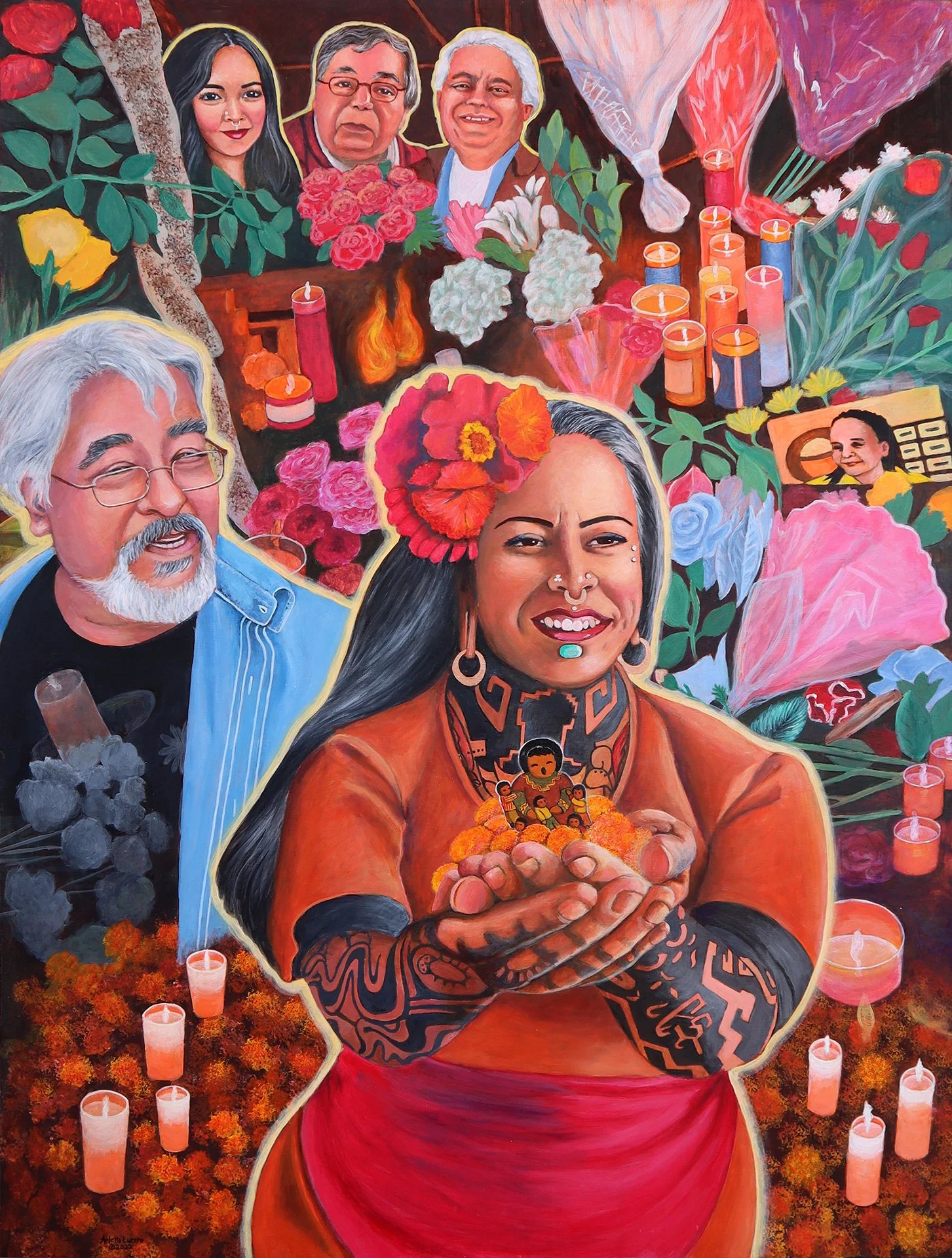
“Those Who Have Passed”
The main character is Alicia Cardenas. I’ve known her for a long time, but right before she was shot, I got to know her really well. And we worked together at CHAC. We had all these plans. We were gonna get together, and when she died, it was not just a shock and terrible for me, but it was terrible for a lot of people. It was a shock to the community. And I was already hurting because November was when my husband died.
She died in December. And my mother died in January of that year. I wasn’t painting it just for me. I was painting it for the community. My husband died. It hurt. When she died. It was like, hurt upon hurt. And so I felt it; I felt it very much. I don’t know. I was devastated, to put it mildly. So I was asked to do a painting in Chicago for Dia de los Muertos. And as I was painting it, I was feeling it. I had, you know, a photo of my husband and I could just see, oh, you were so happy there, and I want to paint you happy. I don’t want to paint her happy. I want to paint her like she is giving to the community. You guys are gone now, But we’re inviting you to come and be with us to spend the day with us. That’s what Dia de los Muertos is all about. We want you to come and join us in our celebration. We’re not grieving, we’re not crying, we’re just loving each other and being with each other.
A ‘Diego-Frida’ Situation:
My husband, Stevon Lucero, was a very well-known artist in the Chicano community. And he founded CHAC, Chicano Humanities and Arts Council, where many, many, many, many artists from this whole area have gathered to show their art. My husband and I would put our art up there on the walls.
When we first got married ... we moved to the mountains in a cabin next to a river. We got a lot of our food by him going out there and fishing, him bringing home the trout and me baking the beans. We had a refrigerator. We didn’t have running water, but we did have electricity, and we had a wood-burning stove. It was very terribly, terribly old fashion. We didn’t have a working television. So everything was just, taking it all the way back, it was romantic!
We painted; we read a lot. We both would read the same book. So he would read sometimes, and he would sit by the river. And then I would take the book, and I would sit in the sun. We took turns in that way. And then we would have discussions about them. It was a way of deeply connecting. But he was always a late riser, stay-up-all-night type of person. My eyes popped open as soon as the sun came up, And that’s how it was all the way to the end... the running water, the way it sounded like in the winter underneath the ice, the birds and the animals, the magic. It was so magical being like that...
Later when CHAC was already created, my husband and some other artists were the ones who started it. But then I came soon thereafter. And so there were other artists that were drawn to that energy. And we would have art shows. And the art shows would not be just paintings. There’d be poets, dancers, musicians, storytellers. There’d be different types of art mediums. We were a new group, and we wanted to bring the neighborhood together. We wanted to bring our Chicano friends together. We didn’t have a lot of money to do that kind of thing. It was just something we did because we could. And that’s how CHAC started really. There was no place for Chicano artists in Denver to show their art.
We were a Frida-Diego situation. He was this bigger-than-life artist, and I was the one who was just quietly doing my stuff in the background. I was more focused, I guess, on my husband and his work, because I believed so much in him that I didn’t focus so much on my career. I felt like I was the breadwinner, I was the homemaker, I was everything to support my husband.
He passed on during COVID. That was very hard. 2022 was extremely difficult for me because he passed on, my mother passed on, one of my really good friends was shot and murdered, and so that was really difficult. I was a caregiver to him, and I was a caregiver to my mother. I would read to her and buy her groceries and make sure everything was okay with her. My siblings were helping too, but I was the primary helper. Stevon passed on, and when that happened, it took a huge emotional toll on me. But I also felt like now I really need to focus on me, for my own sake, for my own health. I knew it was coming. But to me, it was very sudden, because it was a heart attack, and I thought he had more time. I hoped he had more time. So instead of grieving, I spent the year just putting on shows for him. He was at Meow Wolf. Then CHAC had this space in Northglenn, I put on a show there. I just kept putting off the grieving. And I was finishing up a book illustration, and I thought, I don’t want to do this anymore. I can’t do this anymore. I need to focus on me. I need to start doing my own art; I need to really put myself out there as an artist.
And so I started letting things go: I’m not illustrating any more books—be gone with it. I’m not going to be the educator at CHAC anymore—take this over. I’m going to just paint. It took a long time to get to just the painting, but I am painting now. I also did a show in Breckenridge for my husband, but I also built an altar. And so when I built the altar, I guess that was probably the beginning of the real grieving process because after he died, I couldn’t even go downstairs, or in the studio, because that was our time together. The grieving kind of started with that part of it, I guess, hard and heavy. I mean, there’d be times, of course, I would break down and cry here and there because that’s what happened. But I was able to go into his studio and just pull things out. Some of his toys, he liked these little action figure things, you know, painting materials, pictures of him in different situations. So I built this giant altar, and I put it together, tore it apart, put them in boxes, took it to Breckenridge, and then put it back up. And when I had it up in Breckenridge, I just, you know, sat there with music and candles. I could really do a ceremony and invite him to be there with me. It was for Dia de los Muertos, and I could really fully immerse myself into that, which was something I needed…
