Written by Tommy Clift
An account of Amin Saleh’s life is not linear, as he describes it—it’s disconnected, more like 20 separate pieces in a domino effect. When I reflect on our hours in conversation, there’s actually something inherently linear about that—one domino falling onto the next. Different pieces, mismatched in color or origin, but still falling in sequence, each dependent on the last. It’s his particular organized chaos. It’s not a chronological telling, but it is cohesive.
I came away feeling those dominoes were placed by someone more in love with the focus of standing up the pieces than watching them fall.
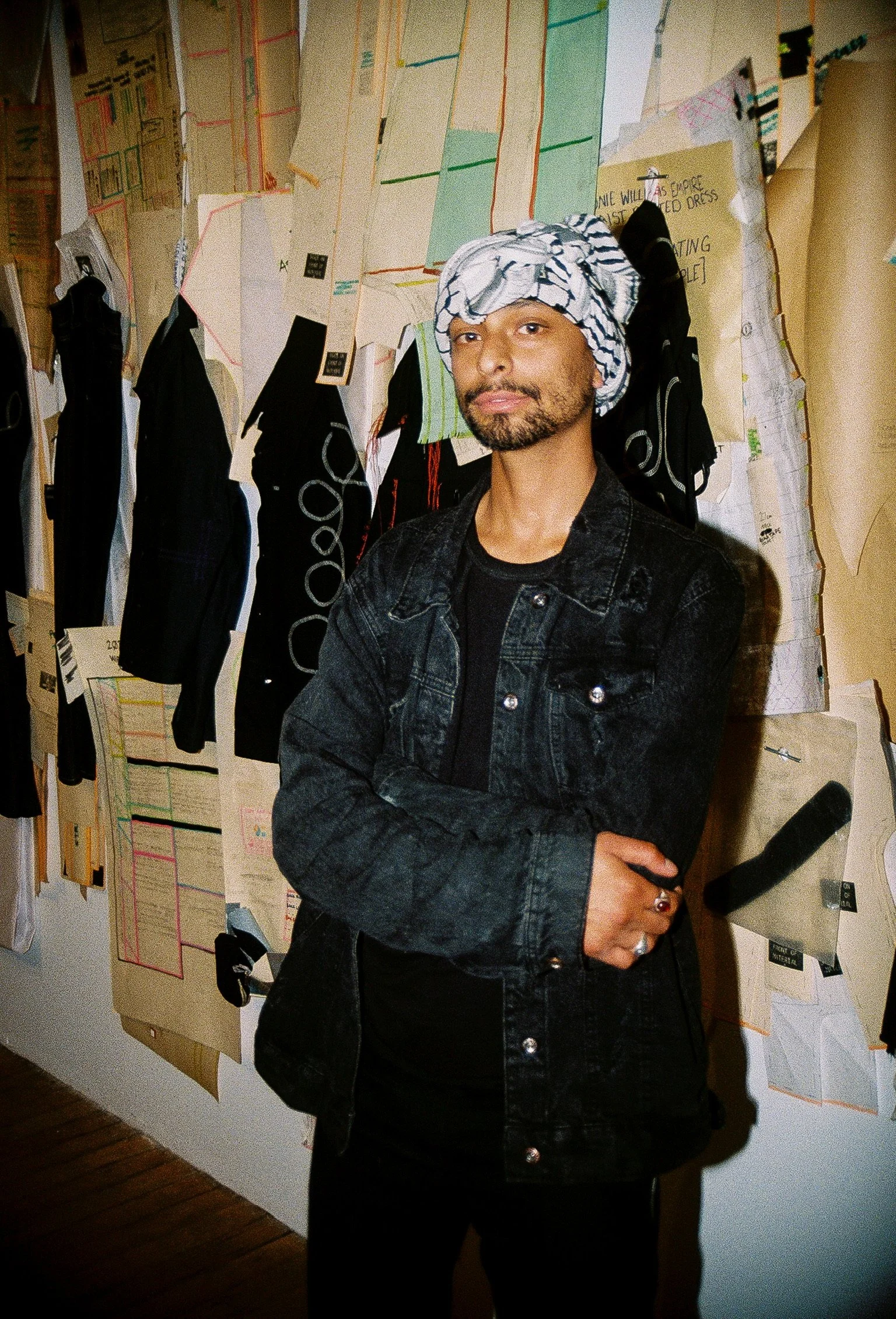
Amin took me back a few years—he was sat in his studio perched off Fairfax, where I’d first met him, frustrated by a leather jacket he was working on. You gotta go take this walk sometimes: a saying he’d often recite that called him down to reset through the streets of West Hollywood that day. It wasn’t long before he found himself passing a group of three young uniformed boys, no older than 14, recycling the phrases of an Israeli doctor who likened killing Palestinians to “eliminating cockroaches.”
Amin sensed it wasn’t their own hateful rhetoric so much as a script rehearsed by kids who’d likely never actually met anyone like him. “I walked up to them. I’m just trying to humanize the situation, like, ‘Hey, I’m Palestinian.’ I was trying to have a conversation with them so they’d have a different perspective, whether they choose to use it or not,” he reflected.
“There was no conversation. They all looked around, and one of the kids, he was leaning on a white picket fence, super white American, and bro pulls out a baseball bat that had nails in it… and he starts running after me.”
As Amin saw it, he had three options: beat up some minors, “that’s not gonna end well for me,” call the police, only to somehow be cast as the one committing a hate crime, or walk away. Like the language they used, the boys’ aggression felt parroted—a puffed-up performance of learned hatred. So he left, confident they wouldn’t follow.
“There is literally no win here,” Amin remembered thinking. “You know, I can't even have a conversation with the youth because the youth is so indoctrinated. That was a real shame to me.”
In another instance, he took one step outside his studio and was cut off by a stranger, her phone out like a weapon in his face, barraging him with the same question over and over: “Why do you hate Jews?”
He’d never seen her in his life. “And I'm not wearing my Kufiya, so she can't guess that I'm Palestinian,” he said. “She came out of nowhere with her phone in her hand already recording, so she must have been waiting.”
Long before October 7, the political realities of the conflict were already embedded in decades of statecraft. But the escalation following the attacks thrust the conflict into millions of new conversations, loud opinions, and protests. For Amin, it intensified familiar expectations.
He’s been chased, baited, and debated on his loyalty and identity in a conflict he has lived in his entire life—expected to play the part of the protestor, advocate, and representative all at once.
“It’s so easy [for people] to throw that on you,” he said. But Amin—with no disrespect to protestors who keep it in public view—seemed less interested in declaring a response than in living his own.
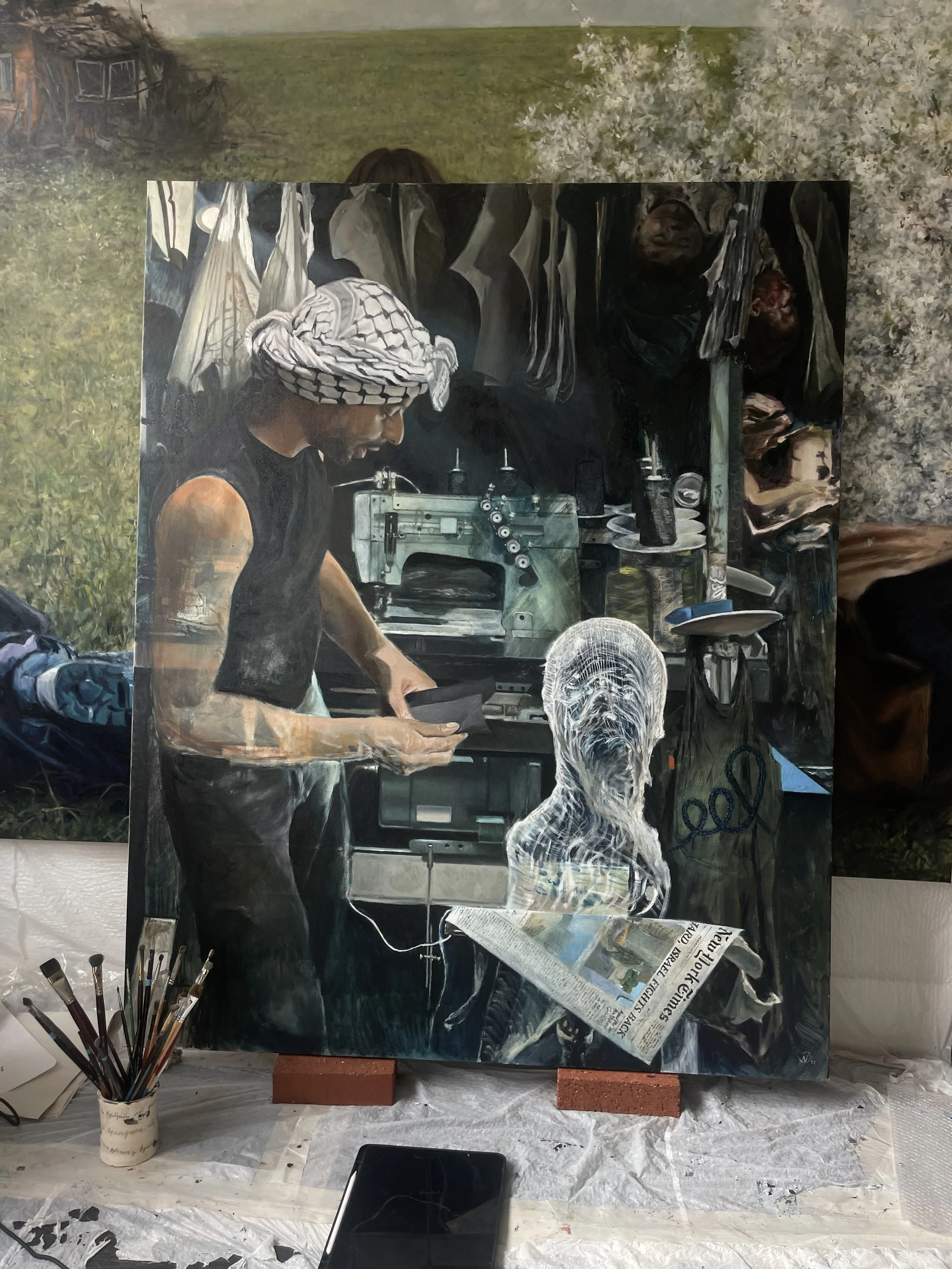
“We did all the yelling, we did all the protesting when I was younger…this shit is not new to me, and it didn't change the situation,” Amin argued. “For me, I'm not a protester, I'm not an activist. I am a designer and a storyteller. I'm a designer, an artist, a storyteller that speaks what's actually happened. And that's it.”
Early Years in Fabric
At around 14, Amin was diagnosed with stage-two non-Hodgkin’s lymphoma—a tumor wrapped around his heart and lungs.
The Make-A-Wish Foundation approached his family, offering the default wish packages to “meet Drake” or give Luke Skywalker a hug. None of it ever interested him. He wanted to refuse the wish altogether, first under the rationale that it should be saved “for someone less fortunate.”
Only after going into remission did his homeroom teacher—who happened to work as a coordinator for the foundation—end up nudging him back towards it: “‘Get your wish, get your wish. C’mon, let’s get your wish.” That extra encouragement was timely, just as a new creative appetite was blooming in Amin’s life.
At that age, Amin’s brother had already pulled him into sneaker culture—reselling Jordans and Nikes, watching New Balance creep into the scene. The noticeable imbalance of sporting $1000 sneakers and hand-me-down clothes started to nag at him. He cycled through silhouettes and brands—goth, indie, darkwave dress concepts—taking cheap jeans to tailors, chasing an elusive “personal style.” At some point, he realized, “I don’t like any of this stuff. Why don’t I just make it myself?”
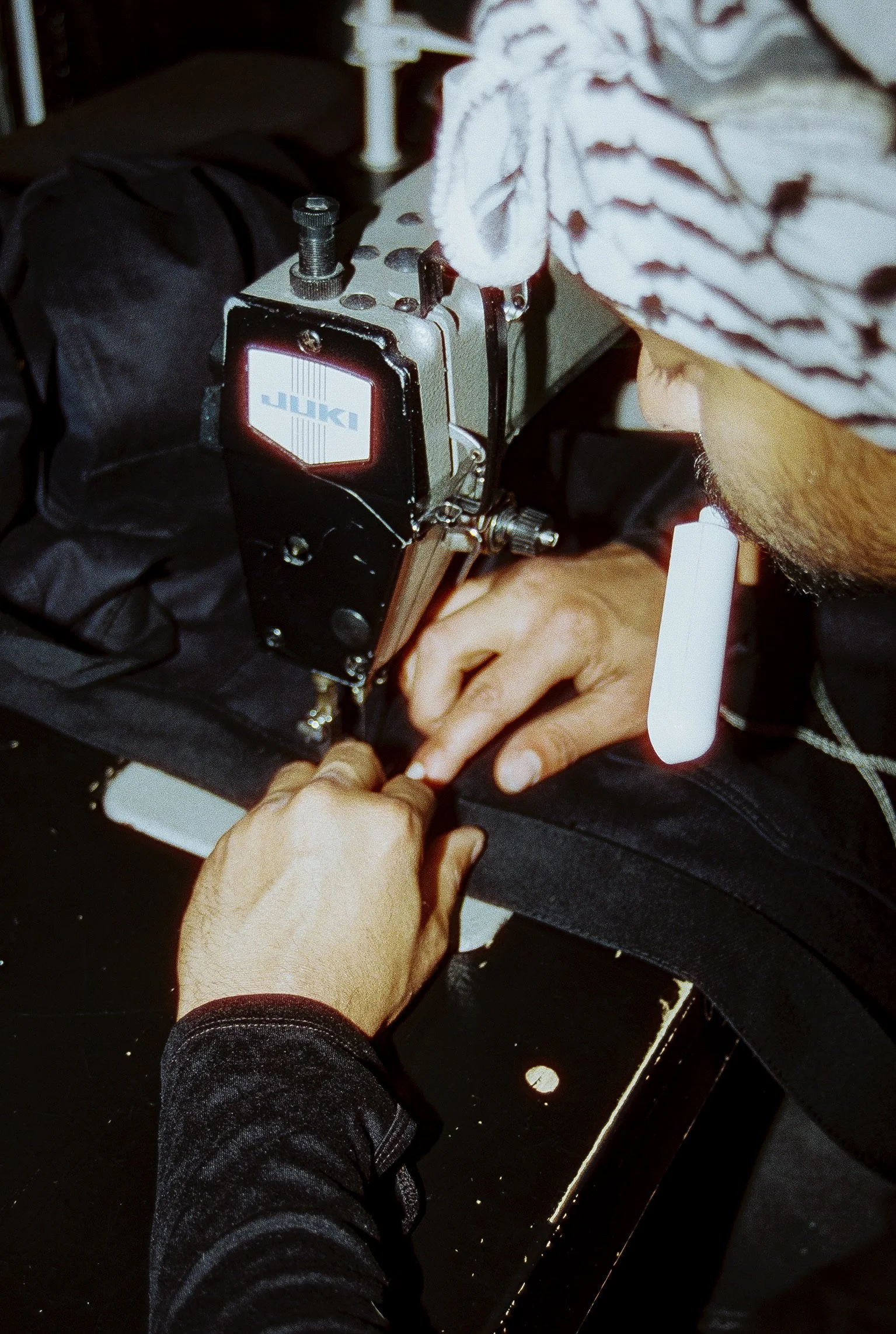
He used his wish to get a sewing machine and supplies, a laptop, and an intro with a local denim maker, Matt Bladwin, in Kansas City.
In his basement, he fumbled his way through those first pairs—jeans flat on the table, cutting around them, guessing at how a zipper might work—rejecting any YouTube tutorials or online fabric rabbit holes. When he got tired of re‑guessing every cut, he drove to Walmart at 1 a.m. and traced the shapes onto a thick science‑fair poster board so he wouldn’t have to start from scratch for each new pair.
“I thought I invented the concept of patterns,” he said with an amused chuckle. “[The board] fell apart so quickly. And it was so expensive.”
It wasn’t until he went back to the sewing machine shop where Make-A-Wish had sourced his equipment that a machinist pulled him aside and gently guided his drive. None of Amin’s ideas were new, the machinist told him; there were already tools for this. He showed Amin the kind of paper he used for patterns and pointed him to an art store that sold it.
“That was a really big moment for me,” Amin said. He started buying rolls of that paper, cutting cleaner shapes, and “just kept making jeans.” For seven years, he refused to sell a single pair.
Sharing Shears
Today, L.A. runs restless with people hoping to be recognized. Amin fits into its pace; he’s palpably alive in the work ethic of his practice. But it’s easy to feel his dedication differs from the cultural norm found in the City of Hustling Angels. He’s not in pursuit of anything but the work itself.
In the years he insisted on not selling anything, he locked into a kind of self-styled, anti-capitalist craft immersion.
“I made literally thousands of jeans,” he reckoned, all while living through residencies, on couches, or crashing on the subway, but never making a dime on a pair. At the time, he saw it as a boycott of economic engagement—though he looks back on that as “a lie,” still unavoidably entangled in the currents of commerce.
But even now, as a designer paid for his art, that instinct hasn’t faltered. When a mutual friend first introduced me to Amin years ago in his L.A. studio, we were barely beyond our hellos when he was offering bespoke pieces at request. My friend Jude had what would become a wardrobe staple within 24 hours of us all meeting.
Amin seems ready, at any given moment, to just disappear into the fabric.
“One of my friends said something about me the other day. He said, in kind of a more critical way—but I took it as a positive thing—he said, ‘You are really in your own world.’ I was like, ‘Fuck yeah, I am. Yeah, bro, I’m 1,000% in my own world.’”
To witness this quality in Amin feels sacred, especially in his artistic practice. “It’s how I interact with God physically in the world,” he told me. “Whenever I pray to God, and I live in this craft, the answer comes back to me.”
When Amin first arrived in the Fairfax studio, he was sharing another room in the building with a friend. He’d been warned about the landlord. Building tenants would tell him, “Watch out for Leo. He’s a hard ass. You don’t want to get on his bad side.”
Once they did finally meet, Amin described them as “best friends from the start.” Leo would knock on his door, working on a project of his own. They’d trade stories, “enjoying each other's company and talking about life. He’d end up with a hat, and I would end up with a pair of jeans.”
Leo, a Polish Jewish 94-year-old, had a lot of stories. During WWII, he escaped Poland only to find himself in a Soviet Gulag. When a guard took him out of general population, he figured he was being moved into isolation—until the sewing machines arrived. Somehow, they’d heard what he could do and began asking him to repair uniforms or make dresses for their wives.
“He survived the Holocaust because he knew how to make clothes,” marvelled Amin.
After the war, Leo immigrated to the States and built a life making dresses for celebrities and wealthy families in L.A.
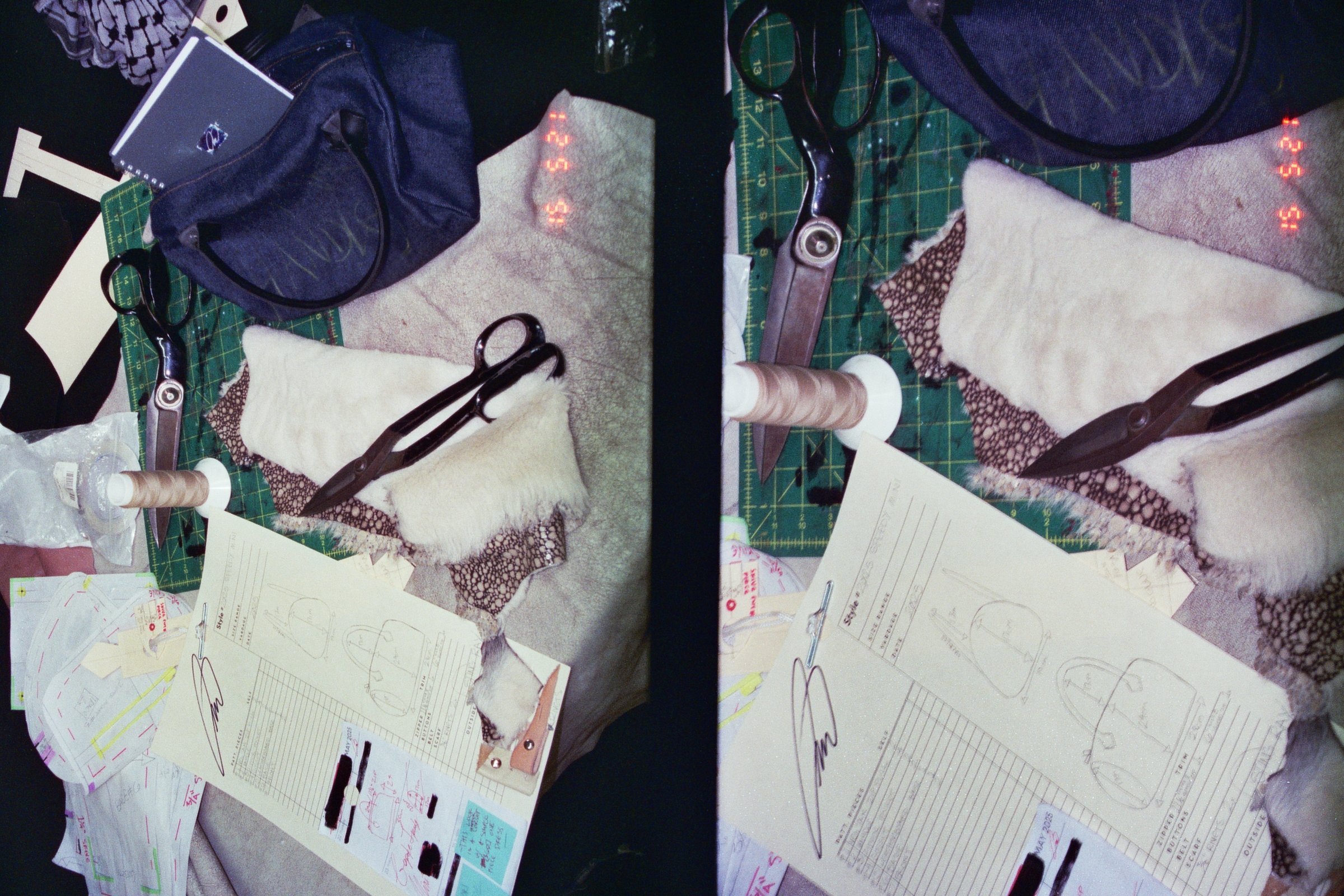
One afternoon in the studio building, Leo brought Amin into a cramped office of cleaning supplies and camera feeds. He pulled out the shears that had secured his survival through the war and helped him build a new life in the U.S.
Leo started to put them back when he stopped, mid-motion. “Actually, I think I'm going to give these to you,” he told Amin, handing him the shears.
The gravity and history of those scissors were not lost on him, but to Amin, there was another unspoken layer. “There’s a culture within designers that they don’t let other people touch their scissors at all,” he explained.
“I do not want you to think that he was pro‑Palestinian,” Amin qualified. “He truly did not believe that Palestine should be a state,” nor does Amin believe Israel should be. They weren’t afraid to cut into it—about the Nakba, about statehood, about the Israelis in the occupied territories who, Amin reminded Leo, “don’t believe in their government at all and protest it daily.”
They were also friends.
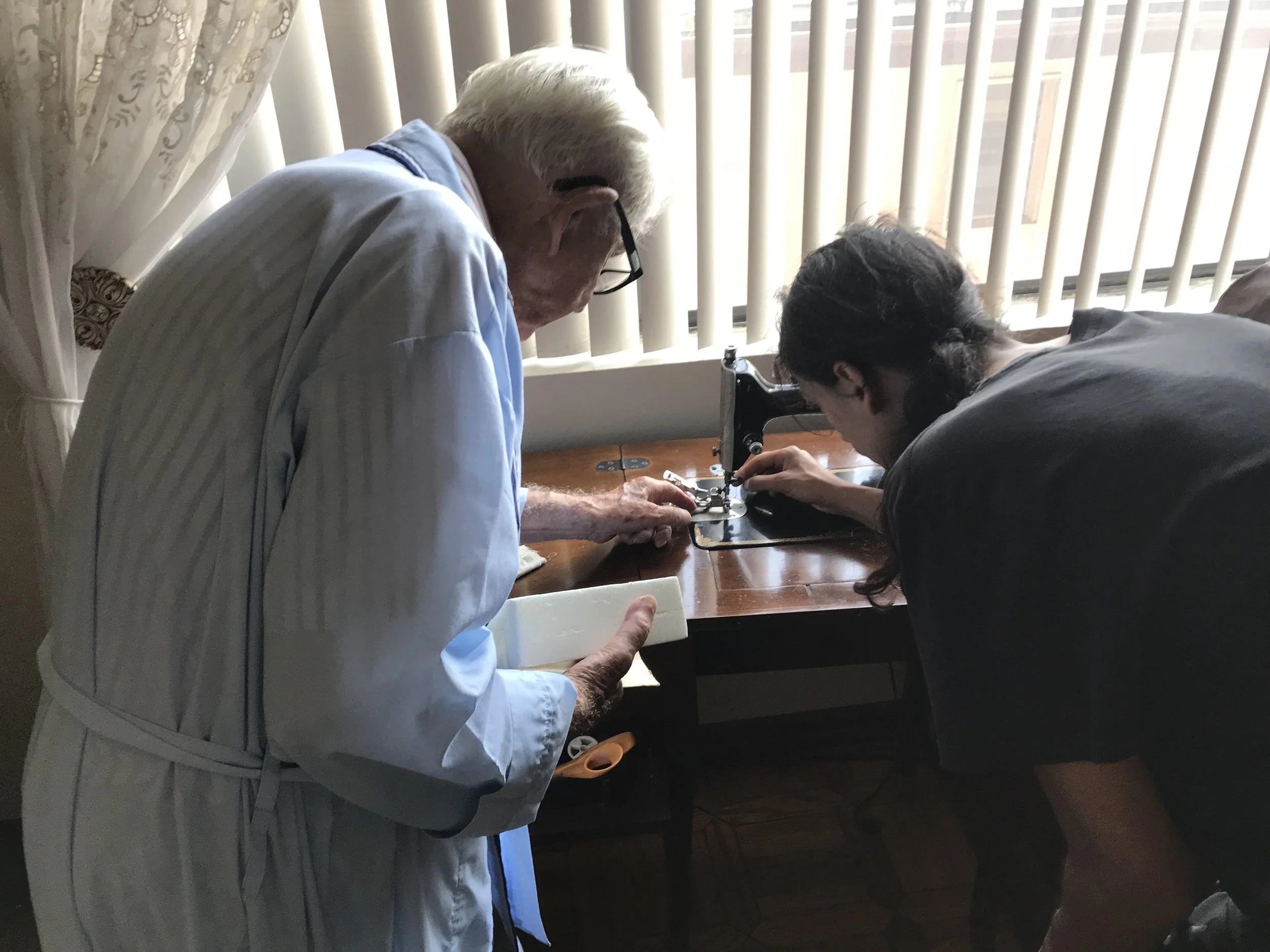
Leo and Amin
Leo is now over 100 years old. Before Covid, Leo waltzed through the building every day, “the most active 94‑year‑old” Amin had ever seen, constantly fixing things up and talking to people in the neighborhood. Amin sensed his cognitive decline wasn’t from age alone, but also the isolation of those years.
The last time they spoke, around three years ago, Leo recognized him at the start of the conversation, but by the end, he mistook Amin for his grandson.
It was clear to me that Amin shared the ease Leo had carried with people for so many years—connecting with difference without letting it become distance, yet still firmly in his own world.
“The world is meant to be cyclical. We are all meant to pull ideas from each other and influence each other, no matter how old anybody is,” Amin said. “In my field, as a designer, I speak to people younger than 14 and people older than 100. And that’s my life.”
Though he never imagined himself teaching, Amin is now working with young designers, long-term apprentices who run studios with him and teenagers learning to draft and sew their first jeans—embodying that cycle of exchanged ideas and learning.
“I really enjoy this craft. I just love the lifestyle of the designer. I love being able to feel the presence of God through my purpose as a designer. It's a beautiful thing, [to] interact with God through the purpose.”