

Written by Nick Van Lente
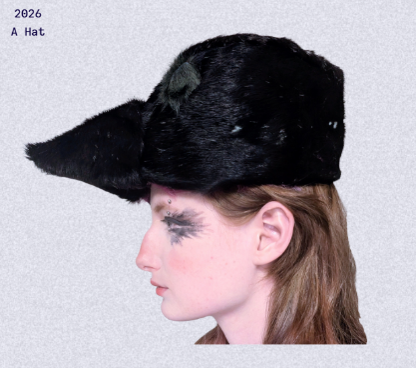
Liana Fay Ruedel's one-bedroom studio is exactly what I thought it would look like. Cool girl, cool apartment. Canvases against the walls, projects in progress, secondhand couches, bronze castings lying around, a Christmas tree in her bathroom, a mattress leaned up against the wall, and stunning natural light. A vision of reined chaos.
The tension I saw in her studio is what comes through when I look at her oil landscapes, her primary medium and subject. In her current project, a multidisciplinary BFA thesis, she plays with the idea that love and hate develop in the same part of the brain. "I was attempting to make sense of something I did not understand in the slightest."
She started this project while training at Interlochen Arts Academy in Traverse City. While she was there, she began learning about our nation's long history of war. From Indigenous genocide to contemporary jingoism, she saw a common thread: war is fueled by love, just as much as hate. "Love for one's country, one's family, hate for the other side." That realization sparked a journey that she's still contemplating today as she prepares for her thesis submission and defense.
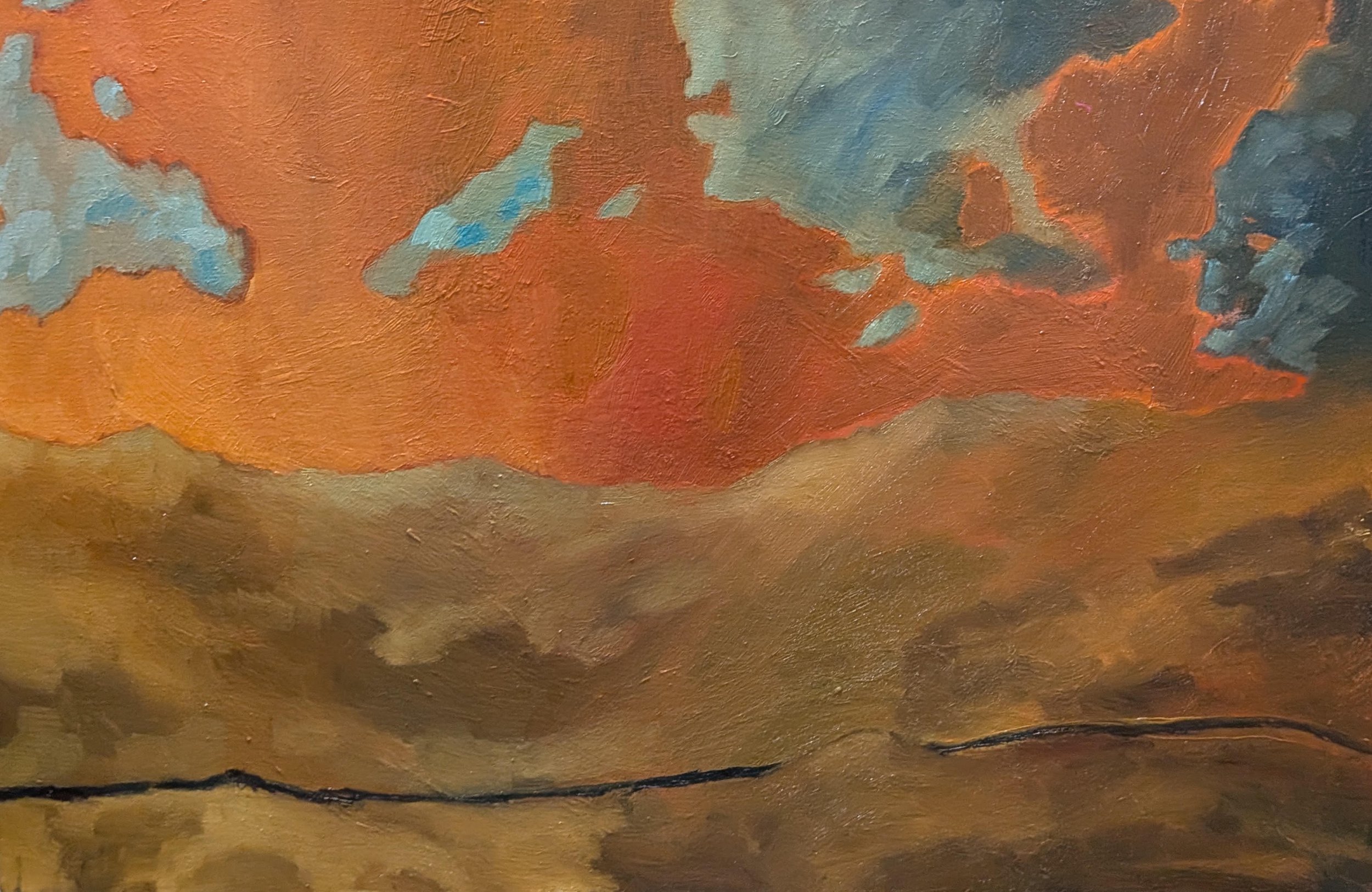
Desert-Patrolled-Road, Oil on Canvas, 18in x 24in. January 17, 2026
In 2023, Ruedel began looking for a scientific framework for the tension between love and hate. In a weeks-long research project, she found that the two responses happen in overlapping regions of the brain. On paper, love and hate look the same. Despite being conceptually opposite, and usually directed toward opposite objects, love and hate share overlapping neural circuits. And the experience of loving or hating, to some degree, looks the same. It is filled with passion, longing, energy, intensity—and it provokes similar bodily reactions: laughing, crying, and sexual arousal.
Conceptually, this idea has been around for a while. Notably, Freud saw the clear connection between love and hate long before neuroscience existed as a discipline. Regardless of how we feel about Freud's canon, he makes some convincing arguments for the ideas Ruedel explores in her art:
“The other conflict, that between love and hatred, strikes us more strangely. We know that incipient love is often perceived as hatred, and that love, if it is denied satisfaction, may easily be partly converted into hatred, and poets tell us that in the more tempestuous stages of love the two opposed feelings may subsist side by side for a while as though in rivalry with each other...The love has not succeeded in extinguishing the hatred but only in driving it down into the unconscious; and in the unconscious the hatred, safe from the danger of being destroyed by the operations of consciousness, is able to persist and even to grow. In such circumstances the conscious love attains as a rule, by way of reaction, an especially high degree of intensity, so as to be strong enough for the perpetual task of keeping its opponent under repression.”
Freud haters should at least agree that what he says about love and hate feels true to experience.
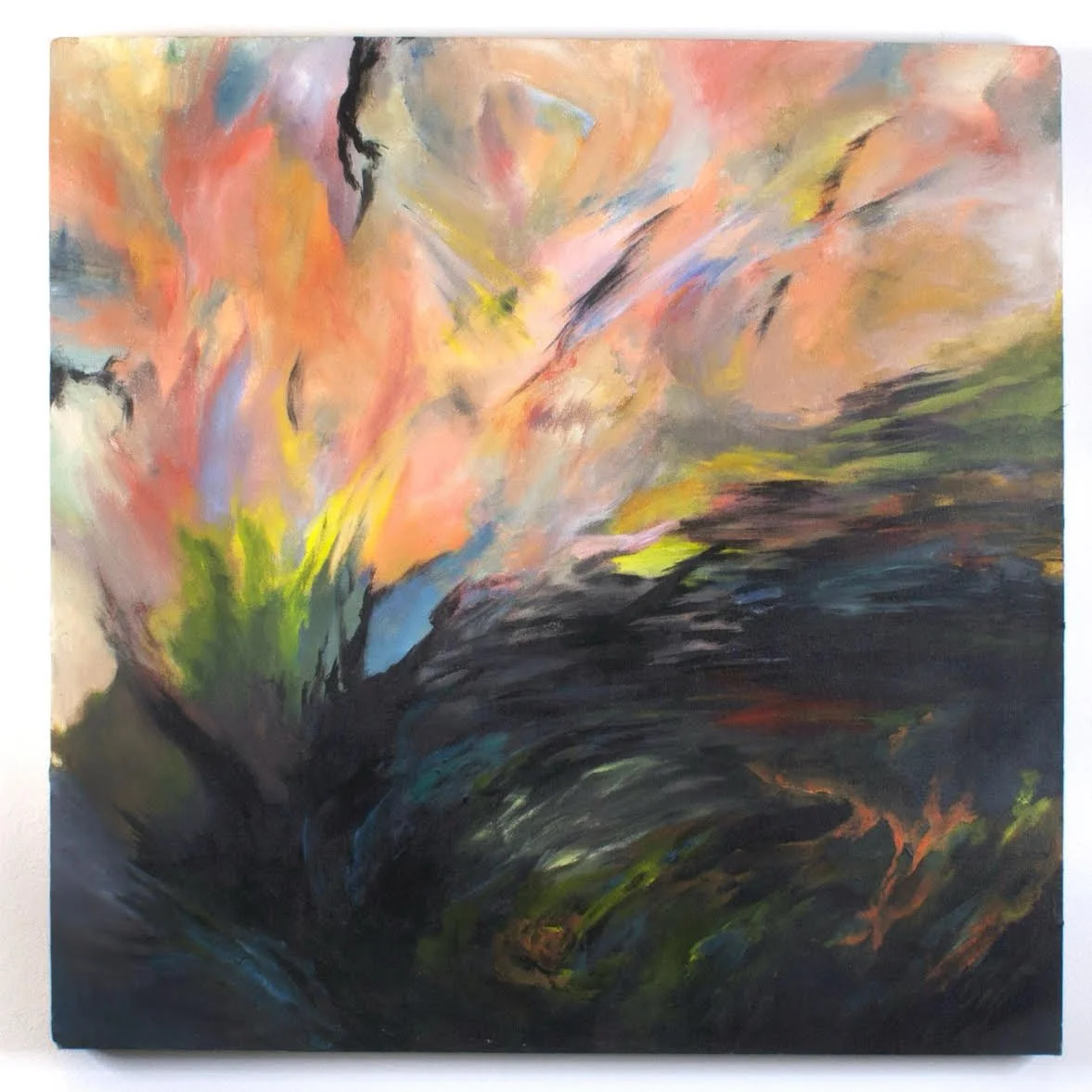
Ruedel's contribution to this conversation, however, has little to do with linguistically articulating this concept. Her landscapes make us feel it, see it. In the work that kicked off this series, War 01, Ruedel offers us the chaos and beauty of a storm. Perhaps not a literal storm (though in a Turner-esque way that’s what I see: a maelstrom) War 01 at least delivers a tension, a war between forces. In the lower half of the canvas, a vortex gyrates. Strokes are hard and fast; they revolve, envelop, twist, pull, rip, gravitate, suck in, chew. Muddled colors—blacks and blacks tinted with blue, yellow, red—show us the dark side of this war. In the upper half, a dreamy sky. Smudged and stretched pinks, oranges, blues, violets. I imagine spinning myself until I’m dizzy and then gazing into a radiant sunset.
(Right: War 01, Oil on Canvas, 48in x 48in. March 6, 2020)
This horizon isn't firm, though. The edge of the darkness is blurry. On the left side of the horizon is what looks like an eruption or a penetration: something shooting into the blackness, splashing up, or something propelling out of it. On the right side, blackness protrudes upwards and becomes lighter. Color gets mixed in, and it almost looks like a reflection: the place where light and dark meet and point at each other. It seems, then, that the line between light and dark, love and hate, doesn't exist—we see a distinction where there is none. Love becomes hate, hate becomes love; hate reflects love, love reflects hate.
While Ruedel generally considers herself a landscape painter, these paintings are non-representational—she wants to let the viewer decide what they see. Her use of movement, contrast, and color evokes a clear tension, a light and a dark—figuratively and/or literally. Call it love and hate; that tension is palpable.
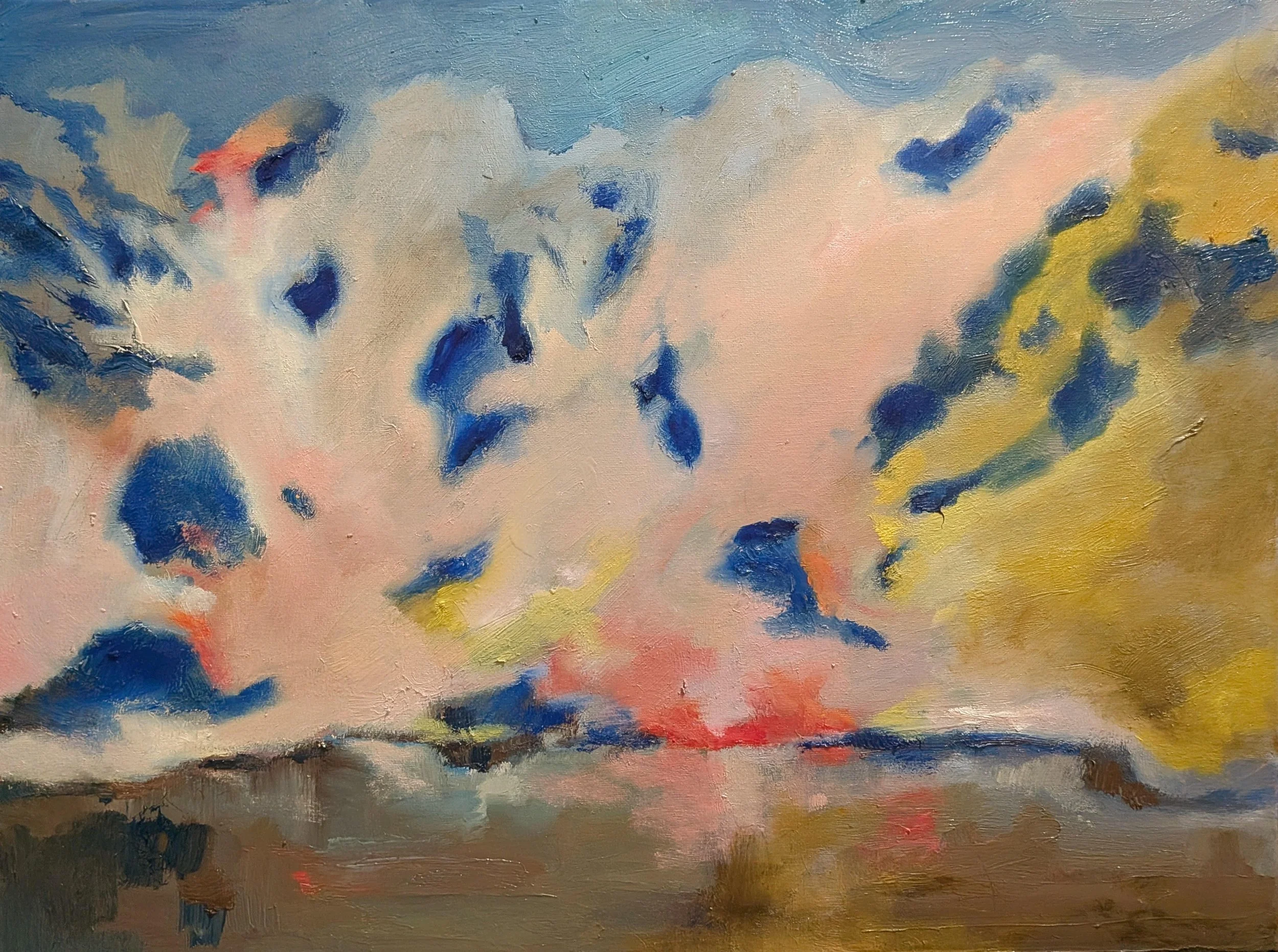
I Was Here, Oil on Canvas, 12in x 20in. April 1, 2026
In one of my favorite paintings that she showed me, I Was Here, huge clouds sit on a horizon. Blue streaks furrow, and washed pinks fill the sky. Something about their hugeness makes the viewer feel small; her audience feels their weight.
"Half of the people I show this to see mountains." Clouds or not, I Was Here places Ruedel's spectator under a massive form. Its scale produces awe and trepidation, the feeling of being one piece in a system that is so much larger than oneself. To feel love in a world of hate; to see hate in a world of love.
Not all of Ruedel's landscapes are quite so abstract. Arriving to Say Farewell shows a horizontally cropped view of the sea, framed by cliffs. Her colors are somber but energetic: green water, green cliffs, mauve-ish sky and its greyed reflection. At once the spectator feels the weight of the brooding sea, a place that toes the line between boundary and frontier.
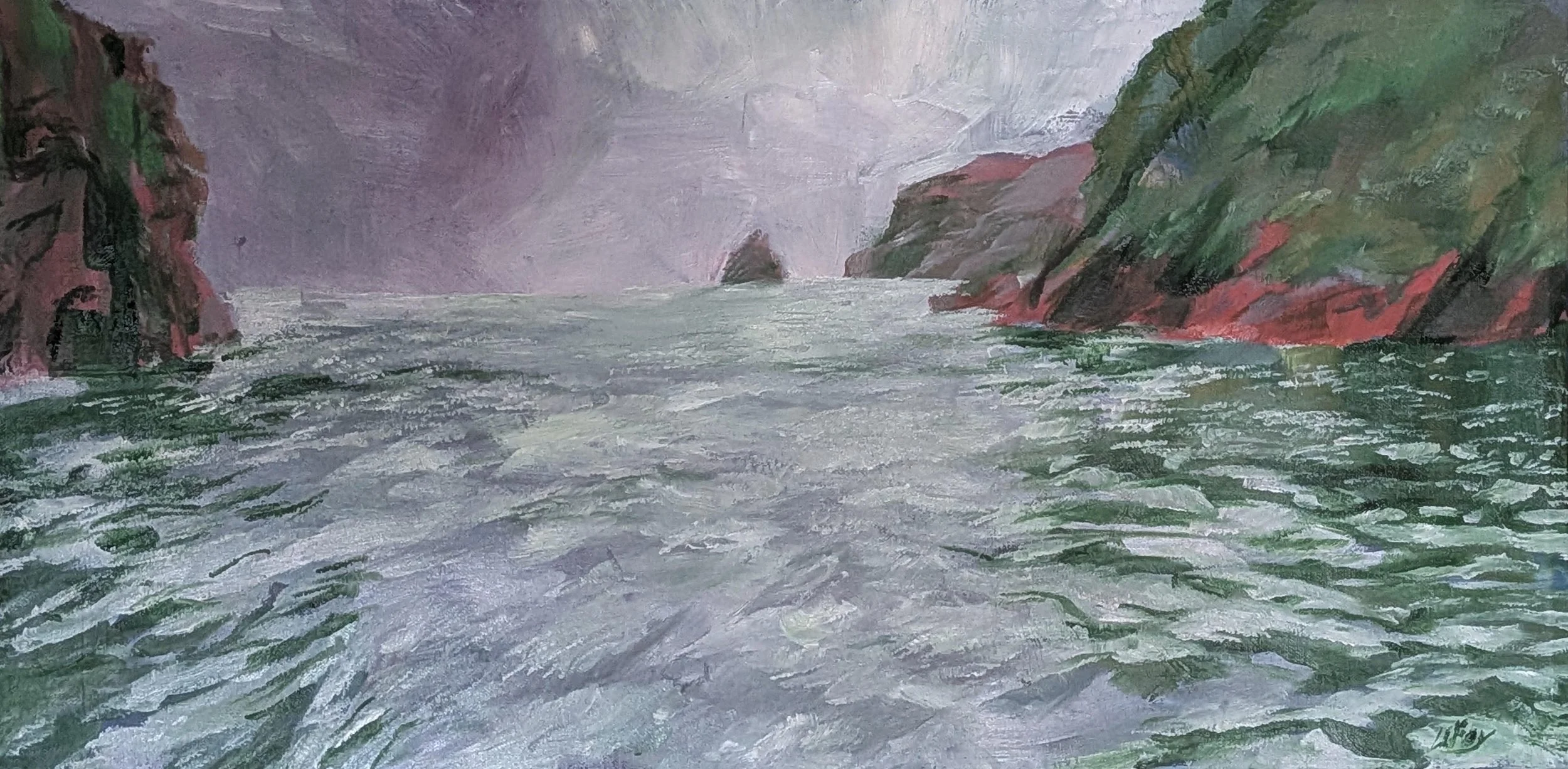
Arriving to Say Farewell (Memories of Paracas), Oil on Canvas, 12in x 24in. January 7, 2026
The way Ishmael looks out to the Pacific feels akin to what Ruedel portrays. If her subtitle, Memories of Paracas, implies that this seascape shows Peruvian waters, then Arriving to Say Farewell feels like a natural addition to what Melville wrote in 1851.
“Nor is it, altogether, the remembrance of her cathedral. toppling earthquakes; nor the stampedoes of her frantic seas; nor the tearlessness of arid skies that never rain; nor the sight of her wide field of leaning spires, wrenched cope-stones, and crosses all adroop (like canted yards of anchored fleets); and her suburban avenues of house-walls lying over upon each other, as a tossed pack of cards;-it is not these things alone which make fearless Lima, the strangest, saddest city thou can’st see. For Lima has taken the white veil; and there is a higher horror in this whiteness of her woe. Old as Pizarro, this whiteness keeps her ruins for ever new; admits not the cheerful greenness of complete decay; spreads over her broken ramparts the rigid pallor of an apoplexy that fixes its own distortions.
Thus, then, the muffled rollings of a milky sea; the bleak rustlings of the festooned frosts of mountains; the desolate shiftings of the windrowed snows of prairies; all these, to Ishmael, are as the shaking of that buffalo robe to the frightened colt!”
Interestingly, Melville attributes Lima's bleakness and the "muffled rollings" of her coastal waters to Pizarro. I like the idea that a landscape can hold the tragedy of human events, that the history of colonialism in Peru might somehow reveal itself in the colors and movements of its waters. Looking at the ocean, one turns away from land, from the history and doings of man. But I wonder if what one turns toward contains something of what one hoped to leave behind: Melville's "silent, superstitious dread."
The first and only time I've been to Paracas was when I was sixteen. I had just completed my first year at a new school and survived a personal tragedy at the hands of someone I thought I could trust. The world had pinned me to the ground. So I booked a flight to Lima, where I could stay with my grandparents and uncle. I thought that maybe a clearer understanding of where my mom came from would make it easier to know where I was going.
I eventually got to a better place; I learned to love my new community and myself within it. But those weeks on the Peruvian coast were painted in shades of grey and green. So I too have Memories of Paracas. I remember turning away from my rocky shoreline and hoping the ocean could symbolize a personal frontier, a threshold to somewhere else, the start of an odyssey, the possibility of other lands. I remember feeling hate and war, even though I knew I was loved, that I had peace.
Ruedel is interested in the space where opposites stop behaving like opposites: where love can look like hate, where beauty can feel threatening, where a landscape can hold both personal memory and historical violence. Her paintings don't resolve these tensions so much as give them somewhere to exist. Perhaps I didn't have the words then for what I saw in Paracas, or what I wanted its landscape to mean. But in Ruedel's seascapes—in most of her oils, for that matter—that feeling exists without needing words.
